A second restaurant, with a sharper route to the table.
We adapted the shared restaurant approach for Taj Indian, then refined navigation, menu browsing and the reservation and order requests for this location. The content and visual pacing put the food and the practical next step together.
The idea behind it.
A second location should feel familiar to the group and distinct to its guests. We used the lessons from Indian Taj to sharpen the moments that matter in Alcúdia.
The group’s second location in Alcúdia needed its own identity and a clearer guest journey. The work built on what Indian Taj had taught us about restaurant discovery, menus, reservations and takeaway.
For people who …
are looking for a table or takeaway in Puerto de Alcúdia.
want to choose dishes, options and spice levels clearly.
need the location, directions and right contact without detours.
Less friction between hunger and action
The questions are simple: where is this restaurant, what can I eat, and how do I get a table or my order? The site answers them in that order.
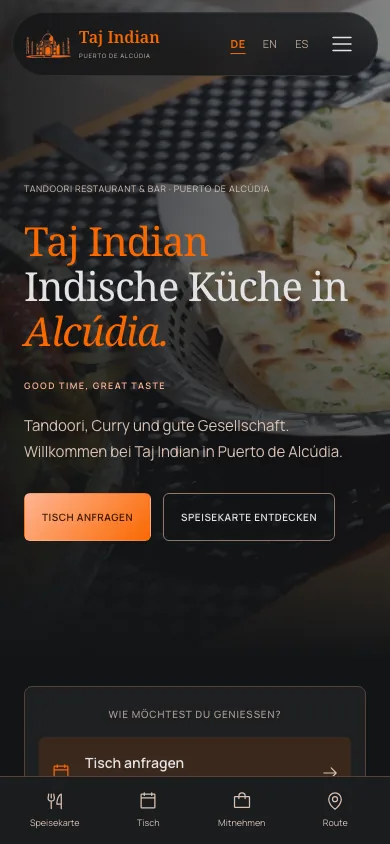
Original German interfaces · captured 31 October 2026
From a first look to a next step.
Understand the location
Photography, address, real menu, hours, contact and maps make Taj Indian concrete. Linked review sources carry trust more honestly than anonymous badges.
Stay in the menu
Guests browse categories and customise a curry from Mild to Phall. The selected heat level survives in the cart, checkout and email to the restaurant.
Send a clear request
The cart review shows the order before submission. Reservations ask for date, time, party size and contact.
A world of its own. With a purpose.
Taj Indian evolves the same family: charcoal, original orange, Noto Serif and familiar food photography. Location-specific content gives it its own place. Practical refinements guide the menu, curry choices and review before submission.
A clear request flow. Built around the operation.
Guests review their choices and details before the request is emailed to the restaurant. The team confirms personally. The interface distinguishes submission from acceptance rather than promising a free table.
- Choices and details
- Email to the restaurant
- Personal confirmation
The right infrastructure for this location
The operator deliberately chose an email-based workflow rather than a restaurant database and admin dashboard. The request flow reports delivery honestly and distinguishes submission from acceptance by the restaurant.
- Three localized site languages and location-specific content
- Structured menu with variants, prices and allergen caveats
- Cart that preserves spice choice through checkout
- Reservation and pickup requests with server-side delivery
- Direct phone, WhatsApp and map actions
- Responsive design with restrained interaction
Where it stands.
The site is publicly accessible. This location deliberately has no restaurant admin backend: table and takeaway requests are sent by email. Submission does not mean a confirmed table or accepted order. Aggregate usage totals are not shown for this workflow.
What it adds up to.
The second location now has a production website and a direct guest journey. We do not display reservation or order totals here because this email-based system has no verified aggregate feed.
Taj Indian is in production with a direct path for guests. A sent request is not presented as an accepted booking, and conversion claims wait for evidence.